DG - IDENTITY WITHOUT ESSENCE
Seven Observational Fragments on Paul Auster’s New York Trilogy
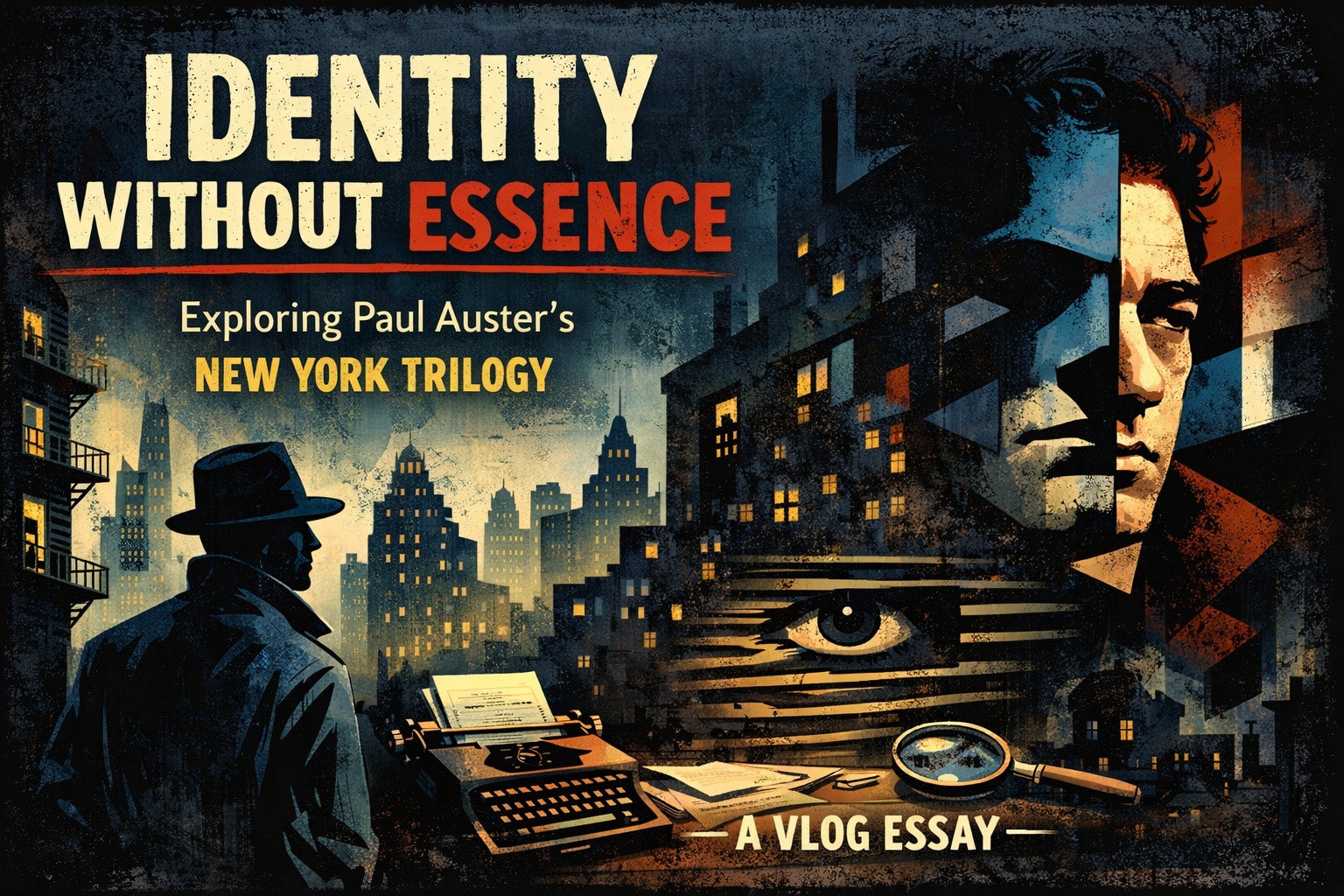
related to: DG - IDENTITÄTEN IN DER POSTMODERNE
I am rereading Paul Auster’s New York Trilogy in its graphic adaptation by Paul Karasik, David Mazzucchelli, and Lorenzo Mattotti. What follows are reflections on Auster’s concept of identity—less a sequence of conclusions than a network of probing questions, fragments formed in the act of rereading. Each point isolates a moment where identity briefly sharpens, only to dissolve again.
IDENTITY WITHOUT ESSENCE
Seven Observational Fragments on Paul Auster’s New York Trilogy
Preamble — Rereading
This return is less about rediscovering plot than tracing conceptual afterimages. The novels do not give answers—they provoke a space of reflection. These fragments are provisional, open, and deliberately unsettled: each is a lens on identity as process, as performance, and as relational effect in a system that constantly observes and reconfigures itself.
FUNCTION
Key Question: What remains of identity when it is reduced to a role?
Identity in Auster’s universe is procedural. Detectives, writers, and observers do not become themselves—they perform. Functions precede subjectivity: observing, reporting, waiting, repeating. The self emerges only within the act of performing the role; it collapses when the function stops. Identity is procedural, not psychological.
OBSERVATION
Key Question: Who watches—and who configures the gaze?
Observation is structural, not neutral. Characters enter systems pre-configured to see and be seen. Watching does not reveal truth—it produces distance, repetition, and uncertainty. Identity is shaped less by knowledge than by the continual pressure of being observed.
NAME
Key Question: What remains when names no longer anchor identity?
Names dissolve, multiply, or vanish. Colors, doubles, absences replace proper names. Reference destabilizes. Without anchors, identity becomes variable, relational, abstract. It is no longer a possession but a position, a temporary node in a network of observation.
LANGUAGE
Key Question: Does language describe the self—or construct it?
Reports, notebooks, and observations proliferate, yet never exhaust their object. Language does not uncover identity; it displaces it. The more characters write, the thinner they become. Identity recedes into sentences, leaving traces of a self that never fully appears.
CITY
Key Question: Is New York a setting—or a cognitive map?
The city is epistemological. Endless streets, mirrors, and detours externalize the logic of identity: recursive, fragmented, centerless. Moving through New York is moving through a system of orientation without certainty.
BLUR
Key Question: What happens when observer and observed collapse?
As distinctions fade, the watcher becomes the watched; the investigator mirrors his subject. Identity circulates, reversible and indistinct. Subjectivity dissolves into relationality, into the system itself.
EMPTY CENTER
Key Question: Is there a core to identity?
At the heart lies absence. Identity has no stable center, no essence. Narrative constructs temporarily organize the void. The self is not found—it is produced, fleetingly, in the interplay of observation, repetition, and system.
EXCURSUS ON POWER
Key Question: Is the system of observation also a system of power?
Power in the trilogy is invisible, structural, and pre-subjective. Authority persists in observation, in assignments without explanation, in self-surveillance. Characters rarely recognize it as external; they internalize it. Auster’s work is quietly political: it reveals how power operates without ideology, coercion, or spectacle—through abstraction, anonymity, and the normalization of being watched.
Focal Points
Identity Without Essence — questions from a rereading of Paul Auster’s New York Trilogy:
- What becomes of identity when names dissolve into colors, doubles, or voids?
- Is a character still a character once biography, memory, and psychology vanish?
- Are Auster’s figures people—or positions within a system of observation?
- When observation becomes a role, who truly acts: the watcher or the system?
- Does the detective seek truth—or merely perform searching?
- When does writing stop describing reality and start producing it?
- Is identity something one possesses, or something one temporarily inhabits?
- What remains of the self when it exists only in reports, notes, and language?
- Are colors in Ghosts symbols—or operators in a closed circuit of meaning?
- When watcher and watched blur, where does subjectivity go?
- Is New York a city, or an epistemological field—a map of deferral and recursion?
- Does surveillance imply power—or only the impossibility of certainty?
- Is the system of observation external, or is language observing itself?
- Can there be an “I” once identity is reduced to function and repetition?
- Is the self an origin—or an effect of narrative constraint?
- What freedom exists inside a structure that precedes the subject?
- Are these figures ghosts because they lack bodies—or because they lack essence?
- How does the reader change when realizing they occupy the same system of observation?
- How does power emerge from observation itself, even without coercion or ideology?
- Can identity be subversive when it exists only as a temporary, relational position?
(Questions, not answers. Notes, not conclusions. A vlog shaped by rereading, reflection, and observation.)
References
- [ ]